Blog Collecting stories
Feber's Fascinating Journey: Pioneers in Toy Valley
The history of the Feber company dates back to the mid-fifties, located in the renowned
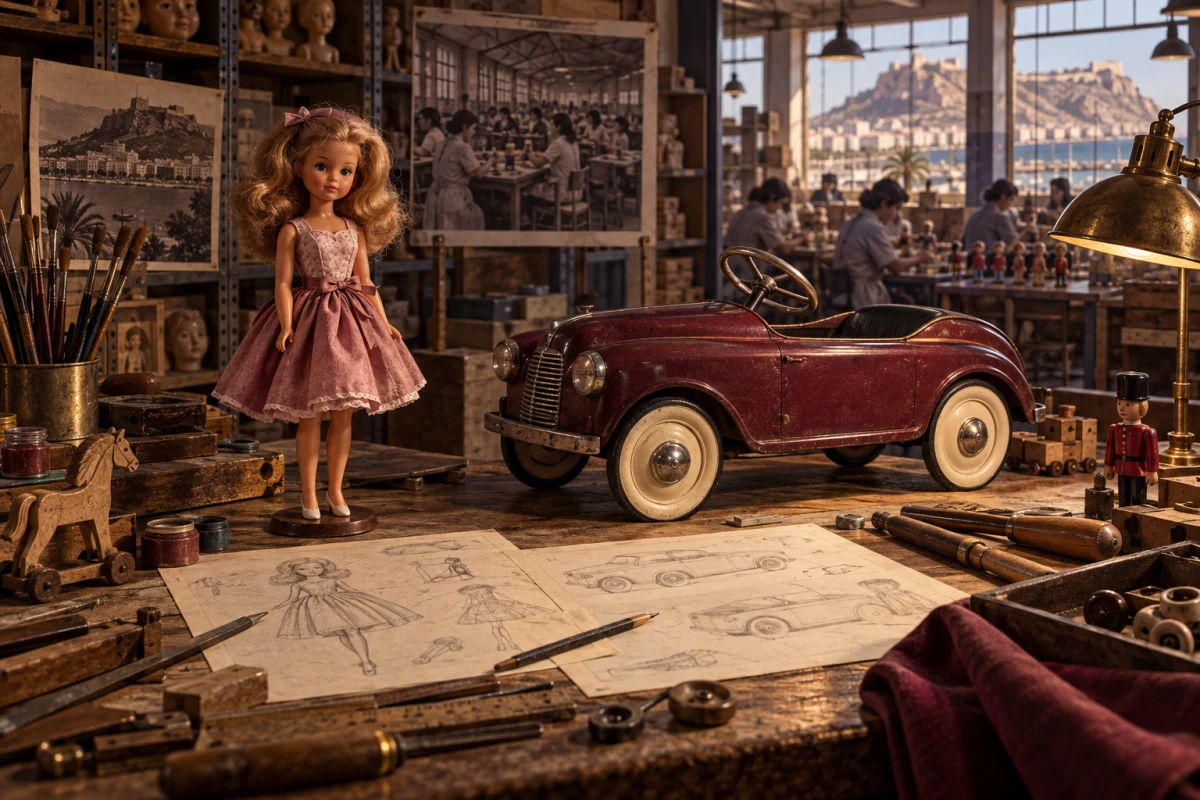
The history of the Feber company dates back to the mid-fifties, specifically in 1956, when it was founded by Mr. José Rodríguez Zurita. This venture, located in the renowned "Toy Valley" in the province of Alicante, Spain, emerged in an environment with a deep-rooted tradition of more than 100 years in the manufacture of toys.
For more than three decades, Feber specialized in the production of family games and little-known dolls. In its early years, it was a modest company with a handful of employees who manually manufactured their toys. However, the 1980s marked a significant change with the arrival of Chabel and other toys that set the standard for the industry.
The introduction of plastic into toy manufacturing in the mid-1950s triggered a revolution in the toy industry. Adaptation to these new materials required large financial investments, but Feber, committed to quality, made these investments, which ultimately resulted in abundant success. Many small manufacturers close businesses or associate and merge with others. It is the new era of plastics: polyethylene, PVC or polyvinyl chloride and polystyrene.
Chabel of Feber
While toy production grew in Spain, in the 1960s, companies such as Takara emerged in Japan in the West. These companies developed the concept of transformable toys in the seventies with lines such as Microman and Diaclone, reaching their peak in the eighties with the famous Transformers.
Around 1967, Asian girls were introduced to the Licca doll, with modern manga features, a creation of the Takara companies. This Japanese doll was the inspiration for the Alicante-born Chabel, who, although similar, had a smaller family and would take a few years to reach the Spanish market. Licca Chan was created in the image of an eleven-year-old girl. She was born in the month of May. She was the first in the class, she was studying fifth grade, she helped with the housework and she loved television series. The Japanese family was made up of her father who is a musician and her mother who is a fashion designer, her grandparents, six siblings: an older sister and twin and triplet brothers and many friends. Just about 13 years later, Chabel would be born in Spain, an almost similar replica of the Japanese one, but with a smaller family, which would take longer to arrive.
Chabel became a complete doll with a wide line of accessories that included dresses, lingerie, rain gear, trips, small modules made up of shops and separate rooms to set up small cities for Chabel, she had her hairdresser, she moved house three times He also had a caravan for trips and a tandem bike for his walks with Dany, a sofa bed and a dressing room, among others, were his accessories. She practiced all kinds of sports and reached the 1992 Barcelona Olympics, among others. From her hairdressing to her participation in the Barcelona Olympics in 1992, Chabel adapted perfectly to the 1980s, a time marked by the economic crisis in Spain.
In the nineties, prestigious designers such as Agatha Ruiz de la Prada partnered with Chabel, creating a unique line of seven dresses and entering the world of toys for the first time.
Chabel had several jobs, such as as an actress, shop assistant, dressmaker, nanny, nurse... She was the lucky one to have the most complete family ever created in Spain, (Dad, mom, siblings and friend) revolutionizing the Spanish toy market and abroad with their own catalogs made especially for them due to the wide selection of accessories and complements they had. She also had the Chabel Club, to which thousands of girls would join through the cards they offered in their cases. Chabel would be one of the best-selling dolls of national manufacture, spreading throughout Portugal, France, Germany and even Italy and with more accessories in Spain behind Nancy from Famosa, although Nancy was a much larger doll than Chabel.
Feber also initiated innovative projects such as Credisa in 1989, an ambitious project that highlighted the company's commitment to the future of toys. The research, design and development of toys were the core of this project, which received praise and awards from various organizations and institutions.
In February 1992, Feber faced financial challenges that led to a salary suspension. Feber would be forced to suspend salaries thanks to the 80 million pesetas of unresolved debts with Comelta and, ninety days after lifting the Feber suspension of payments. However, in May 1993, he would announce a strong expansion plan abroad with greater product diversification that would never happen. From these dates onwards production would stop, but not marketing, for this last reason we can see Chabel boxes for sale with models that do not correspond at all, especially in the latest models marketed: Difussion, Yeýes in Bicycle boxes, Navy Club in a Vips box, Snow shelters prepared as if they were going to have light, but did not include it (for these models they took advantage of those from Cinderella's luminous house) and countless Chabel dolls and Feber dolls mixed together.
Until its sale in 2006, Feber remained a leading force in the toy industry, with annual production exceeding one million units and a presence in more than 60 countries. . The main products it designed and manufactured in the late 90s were electric vehicles (rechargeable battery) with more than 50 different models, outdoor games, play parks, etc. And preschool games. Chabel and many of the toys that made up Feber: Few Pecas, BabyFeber, FeberBoys, Estrella, Sol y Luna... They were already a vague memory for the company that gave birth to them and saw them born, in fact, they cared little or nothing about what would happen with them. The acquisition by Famosa in 2006 consolidated industrial leadership in the area, maintaining research, development and design in Spain.
Awards that Feber won
Feber, throughout its history, has won several awards for the quality and innovation of its toys, and its factory in Ibi stood out as unique in Europe by covering everything from design to product marketing.
- 1989: Bronze and Silver Ring for best toy
as a child (Spain). - 1991: Valencia-Innovation (Spain).
- 1995: Gold Award Winner (United Kingdom).
- 1995: Toy of the year, Australian Toy Association (Australia).
- 1996: Gold Award Winner (United Kingdom).
- 2000: Golden J for innovation (Fr).
- The company obtained the ISO 9001 certificate in 1995 granted by TÜV MANAGEMENT SERVICE, being one of the first European toy companies to obtain this recognition and the first in Spain.
The sale of Feber
The sale of Feber to Famosa marked the end of an era and thus made it the leading company in the "outdoor" and battery-powered vehicle categories. The purchase operation consolidated the industrial focus of the area and marked the beginning of an exciting new stage for both brands, with the aim of consolidating themselves as leaders in all European markets and expanding to more than one hundred countries. With more than 250 employees, Famosa continued Feber's legacy, further establishing Toy Valley as a key epicenter in the toy industry.
Mr. Ferre indicated during the purchase: - "With this operation an exciting stage has begun", with the aim of establishing the Famosa and Feber brands as leaders in all European markets and in more than one hundred countries in which both companies have a presence. with a great presence." Ferre also stressed; - "All research, development and designs will be carried out in Spain, specifically in the Alicante towns of Ibi and Onil, located in the Toy Valley."
Did you enjoy this story?
Save it with a like